Mikotea — herbal blend for a foot soak: what is in it, how to brew it, and where it is sold
Mikotea is a 50 g blend of dried herbs from which you brew a foot soak. It contains lavender flower, licorice root, walnut leaf and greater celandine. One portion, 1–1.5 litres of boiling water, twenty minutes to steep, then half an hour with your feet in it. It is never taken by mouth.
What Mikotea is — and what it is not
Mikotea is a cosmetic herbal blend for external use, packed as 50 g of dried plant material. From it you prepare a solution for soaking the feet. Despite the name, it is not a tea: it is not drunk, and it is not a medicine.
The idea is as old as folk cosmetics. A warm herbal soak softens thickened skin and the nail plate, so that clippers and a file work afterwards instead of tearing and splitting the edge. That preparatory step is the one most people skip — and then wonder why their nail care produces nothing.
A 50 g pack gives five to seven soaks, depending on how generously you measure each portion. At the recommended rhythm of one or two soaks a week, that is roughly a month of use.
The scent is distinctly herbal, with lavender in front and a mild sweetness from the licorice. The water turns dark during steeping — that is expected from a decoction containing walnut leaf and greater celandine, and it is not a sign that anything is wrong.

The four herbs
| Herb | Botanical name | Part used and role |
|---|---|---|
| Lavender flower | Lavandula flos | Flower. Carries the scent and gives the blend its calming character; lavender has been used in foot baths for centuries. |
| Licorice root | Glycyrrhiza radix | Root. A classic component of herbal blends; in decoctions it lends a mild, rounded character that tempers the sharper herbs. |
| Walnut leaf | Juglans folium | Leaf. Traditional in skin baths and the reason the decoction turns dark. |
| Greater celandine | Chelidonium majus | Aerial parts. A well-known folk plant for external skin care, present in a small proportion as part of the classic recipe. |
Mikotea is not drunk and is not used as a tea. Do not soak feet that have open wounds, cuts or inflammation. In diabetes and in circulatory conditions, warm foot soaks must be agreed in advance with the professional who follows you — reduced sensation makes it easy to misjudge water temperature.
How to prepare the soak
- 1
Pour boiling water over one portion
One portion of the blend with 1–1.5 litres of boiling water. Cover and leave for about 20 minutes.
- 2
Cool to a comfortable temperature
Check with your hand, not your foot. The water should be warm, not hot. Add cold water if needed.
- 3
Soak the feet for 30 minutes
Afterwards dry the feet thoroughly with a clean towel, paying particular attention to the spaces between the toes.
The order that works is soak → dry → cut and file → gel. Wash the towel at a high temperature afterwards and do not share it. Nothing about this is complicated; it just has to be done in that sequence to be worth doing at all.
What a soak does and does not do
| Timeframe | What to expect |
|---|---|
| Immediately after | Skin and nail plate are softer; cutting and filing become markedly easier. |
| The same evening | A sense of relief in the feet, particularly after a long day standing. |
| After 3–4 soaks | Heels are smoother and nail edges split less when cut. |
| Long term | The soak complements daily care. The appearance of the nail plate changes only as it grows out, over months. |
Do not soak every day. Prolonged and frequent immersion dries the skin instead of caring for it. Once or twice a week is enough, and more is not better.

Who uses it, and when
A soak is not a daily ritual — it is a preparatory step, and it earns its place at specific moments rather than every evening. These are the situations people describe most often.
Before cutting thickened nails
The most common reason by far. A hard plate splits and tears when cut dry; after half an hour in warm water, clippers go through it cleanly and a file does the rest.
After a long day standing
Twelve-hour shifts in closed footwear — hospitality, retail, production. The soak is the simplest way to close the day, and the relief is immediate rather than theoretical.
For dry, cracked heels
Softened skin can actually be worked on with a file, and a cream applied afterwards absorbs instead of sitting on the surface.
Helping an older relative
When bending down is difficult, the soak turns nail cutting from a twenty-minute struggle into a two-minute job — for both people involved.
As a fixed weekly slot
Most people attach it to Sunday evening: soak, cut, file, gel. Anchoring it to a specific evening is what makes it survive past the second week.
After sport
Running, football, gym. Not because of the nails, but because half an hour of warm water is a reasonable way to end a training week.
Is a herbal soak different from plain warm water?
An honest question, and worth answering honestly. Most of the softening effect comes from the warm water itself — that is simple physics acting on keratin, and plain water would do a substantial part of the job.
What the herbs add is the part cosmetics are actually for: the scent, the character of the water, and the sense that this is a deliberate care routine rather than a bowl of water. In practice that matters more than it sounds, because the thing that determines whether a weekly routine survives is whether it is pleasant enough to repeat. A blend with lavender and licorice is repeated; a bowl of tap water usually is not.
| Plain warm water | Mikotea decoction | |
|---|---|---|
| Softening the plate | Yes — most of the effect is thermal | Yes, same mechanism |
| Scent and character | None | Lavender-forward, mildly sweet from the licorice |
| Colour of the water | Clear | Dark, from the walnut leaf |
| Cost per session | Nothing | Roughly one seventh of a 50 g pack |
| Likelihood of repeating it weekly | Low, in most people’s experience | Higher — which is the entire practical argument |
We would rather state that plainly than imply the herbs do something they do not. If you want the mechanical benefit alone, warm water is genuinely most of the way there. The blend exists because a routine you enjoy is a routine you keep.
Where Mikotea is available
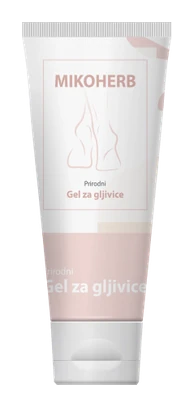
Mikotea is currently distributed in six of the nine markets: Serbia, Bosnia and Herzegovina, Montenegro, North Macedonia, Albania and Kosovo. In Bulgaria, Slovenia and Croatia only the Mikoherb gel is available at the moment.
Order Mikotea in your country
Cash on delivery, no prepayment, and a consultant who confirms the details in your language.
Choose your countryQuestions people ask
Is Mikotea drunk like a tea?
No. Despite the name it is strictly for external use — a blend from which you brew a foot soak.
How many soaks does one pack give?
A 50 g pack usually gives five to seven soaks, depending on how much you measure per portion.
Why does the water turn dark?
Because of the walnut leaf and greater celandine. A darker decoction is normal and expected.
Can it stain the skin?
With longer soaking the skin may take on a faint yellowish tone that washes off. This is typical of walnut-leaf decoctions.
How often should it be used?
Once or twice a week. Daily soaking is not recommended because prolonged immersion dries the skin.
How should the blend be stored?
In a well-closed container, in a dry place, protected from light and moisture. Damp is the main enemy of dried herbs.